
Requires a Java Enabled Browser.

About Batteries

[Trojan Website] [About Batteries]

Home
About Us
Where to Buy
Automotive
Deep Cycle
Cell / Cordless
2-Way Radios
Industrial
Marine & RV
Standby Power


Batteries - All You Ever Wanted to Know


Batteries - Overview
bulletBattery Voltages
bulletBattery Charging
bulletBattery Chargers
bulletBattery Size Codes
Battery Applications:
bulletAutomotive / SLI
bulletMarine Deep Cycle
bulletIndustrial Deep Cycle
bulletDeep Cycle
Battery Construction
bulletFlooded
bulletGelled Electrolyte
bulletAGM
bulletSealed
Misc.:
bulletBattery Temperature
bulletCharge Controllers
bulletCycles vs. Life
bulletMaximizers

Batteries - An Overview:

A battery is an electrical storage device. Batteries do not make electricity, they store it, just as a water tank stores water for future use. As chemicals in the battery change, electrical energy is stored or released. In rechargeable batteries this process can be repeated many times. Batteries are not 100% efficient - some energy is lost as heat when charging and discharging. If you use 1000 watts from a battery, it might take 1200 watts or more to fully recharge it. Slower charging and discharging rates are more efficient. A battery rated at 180 amp-hours over 6 hours might be rated at 220 AH at the 20-hour rate, and 260 AH at the 48-hour rate. Typical efficiency in a lead-acid battery is 85%, in a NiCad battery it is about 65%.

Nearly all large rechargeable batteries in common use are Lead-Acid type. (There are some NiCads in use, but for most purposes the very high initial expense does not justify them). The acid is typically 60% Sulfuric acid and 40% water. NiFe (Nickel-Iron) batteries are also available - these have a very long life, but rather poor efficiency (60-70%) and the voltages are different, making it more difficult to match up with standard 12v/24/48v systems.

Return to Top

Major Battery Types

Batteries are divided in two ways, by application (what they are used for) and construction (how they are built). The major applications are automotive, marine, and deep-cycle. The major construction types are flooded (wet), gelled, and AGM (absorbed glass mat).

Application:

Automotive, or SLI (starting, lighting & ignition)
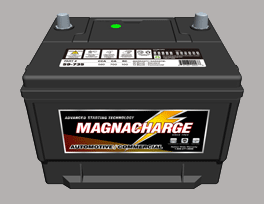
SLI batteries are commonly used to start and run automobiles, where a very large starting current is needed for a short time. SLI batteries have many very thin plates with a large surface area, designed to be discharged no more than 1 to 5% from full charge. These can be damaged quickly if deep cycled.
 
Marine / Deep Cycle
Deep cycle batteries are designed to be discharged down as much as 80% time after time, and have much thicker plates.
The so-called Marine deep-cycle batteries are actually a "hybrid", and fall between the SLI and deep-cycle batteries. These should not be discharged more than 50%. SLI batteries are usually rated at "CCA", or cold cranking amps, or "MCA, Marine cranking amps". Any battery with the capacity shown in "cranking amps" is NOT a deep-cycle battery, and some marine batteries with MCA ratings may be a hybrid (basically a battery with thicker plates than an automotive battery, but thinner than a true deep-cycle).
 
Return to Top
 
Industrial deep cycle batteries
Sometimes called "fork lift", "traction" or "stationary" batteries, these are used where power is needed over a longer period of time, and are designed to be "deep cycled", or discharged down as low as 20% of full charge (80% DOD, or Depth of Discharge). These are often called traction batteries because of their widespread use in forklifts, golf carts, and floor sweepers (from which we get the "GC" and "FS" series of battery sizes). Deep cycle batteries have much thicker plates than automotive batteries: Automotive batteries typically have plates about .04" (40/1000") thick, while forklift batteries may have plates as much as 1/6" (170/1000") thick - 4 times as thick as auto batteries. Most industrial deep-cycle batteries use Lead-Antimony plates rather than the Lead-Calcium used in most deep-cycle batteries. The Antimony reduces gassing when these batteries are subjected to their normal very high charge and discharge rates.
 
Deep Cycle Batteries
Deep cycle batteries are designed to put out 80% of their capacity time after time without damage. Automotive batteries can be severely damaged if heavily discharged a few times. If discharged 80% and then recharged fully, deep cycle batteries can handle from a few hundred to 1000 complete cycles, where an automotive battery might be able to last for only 30 to 50 cycles. Deep cycle batteries may not work well in automobiles because they are not designed to put out the massive power needed for startup. Many marine and RV batteries are "dual purpose" - these are deep cycle batteries that will also work as SLI batteries. Nearly all marine and many industrial batteries are sealed and may also be gelled, glass mat, and/or maintenance free. "Sealed" batteries are not totally sealed - the actual name for them is "Valve Regulated Sealed Lead-Acid Batteries", or VRSLB, sometimes called VRLA, or "Valve Regulated Lead-Acid".
 
Return to Top

Construction:

Flooded
These batteries may be standard or the so-called "maintenance free". All gelled batteries are sealed and a few are "valve regulated", which means that a tiny valve keeps a slight positive pressure. Nearly all AGM batteries are valve regulated..
 
Gelled Electrolyte:
Gelled batteries, or "Gel Cells" contain acid that has been "gelled" by the addition of Silica Gel, turning the acid into a solid mass that looks like hard Jell-O. The advantage of these batteries is that it is impossible to spill acid even if they are broken - the disadvantage is that they must be charged at a slower rate (C/20) to prevent excess gas from damaging the cells. They cannot be fast charged on a conventional automotive charger or they may be permanently damaged. This is not usually a problem with solar electric systems, but if an auxiliary generator or inverter bulk charger is used, current must be limited to the manufacturers specifications. Most better inverters commonly used in solar electric systems can be set to limit charging current to the batteries.

Return to Top

AGM
A newer type of sealed battery uses "Absorbed Glass Mats", or AGM between the plates. These type of batteries act just like gelled, but can take much more abuse.
 
Sealed Batteries
These batteries are made with vents that cannot be removed. Maintenance free batteries are also sealed. Sealed batteries are not totally sealed, as they must allow gas to vent during charging. If overcharged too many times, these batteries can lose enough water that they will die before their time. Most deep cycle batteries use Lead-Calcium plates for increased life, although most forklift batteries use Lead-Antimony. A few industrial batteries have special caps that convert the Hydrogen and Oxygen back into water, reducing water loss by up to 95%. Lead-Antimony batteries have a much higher self-discharge rate than Lead or Lead-Calcium, but the Antimony improves the mechanical strength of the plates, which can be an important factor in electric vehicles. They are generally used where they are under constant or very frequent charge, such as fork lifts and floor sweepers. The Antimony increases plate life at the expense of higher self discharge. If left for long periods unused, these should be trickle charged to avoid damage from sulfation.

Return to Top

Battery Size Codes

Batteries come in all different sizes. Many have "group" sizes, which is based upon the physical size and terminal placement. It is NOT a measure of battery capacity. Typical BCI codes are group U1,24, 27, and 31. Industrial batteries are usually designated by a part number such as "FS" for floor sweeper, or"GC" for golf cart. Many batteries follow no particular code, and are just manufacturers part numbers. Other standard size codes are 4D & 8D, large industrial batteries, commonly used in solar electric systems.

Temperature

Battery capacity is reduced as temperatures go down. This is why your car battery dies on a cold winter morning. Capacity is increased at temperatures over 25 C (77 F), but battery life is shortened. Battery capacity is reduced by 50% at -22 degrees F. Battery life is reduced at higher temperatures - for every 15 degrees F over 75, battery life is cut in half, for ANY type of Lead-Acid battery, whether sealed, gelled, etc.

Cycles vs. Life

A battery "cycle" is one complete discharge and recharge cycle. It is usually considered to be discharging from 100% to 20%, and then back to 100%. Battery life is directly related to how deep the battery is cycled each time. If a battery is discharged to 50% every day, it will last about twice as long as if it is cycled to 80% DOD. If cycled only 10% DOD, it will last about 5 times as long as one cycled to 50% - but to do so, you would need a very large battery capacity in most cases.

Return to Top

Battery Voltages

All Lead-Acid batteries supply about 2.14 volts per cell when fully charged. Batteries that are stored for long periods will eventually lose all their charge, at about 1% to 10% per month. A "float" charge should be maintained on the batteries even if they are not used. Batteries self-discharge much faster at higher temperatures. The old myth about not storing batteries on concrete floors is just that - a myth. Lifespan can also be seriously reduced at higher temperatures - most manufacturers state this as a 50% loss in life for every 15 degrees F over 77 degrees cell temperature. Lifespan is increased at the same rate if below 77 degrees, but capacity is reduced at lower temperatures at the rate of 10% per 15 degrees F. Most deep cycle Lead-Acid batteries are actually an alloy of Lead and Calcium and/or Lead and Antimony for better plate life.

State of Charge
State of charge, or conversely, the depth of discharge (DOD) can be determined by measuring the voltage and/or the specific gravity of the acid with a hydrometer. This will NOT tell you how good the battery condition is - only a sustained load test can do that. Voltage on a fully charged battery will read 2.12 to 2.15 volts per cell, or 12.7 volts for a 12 volt battery. At 50% the reading will be 2.03 VPC, and at 0% will be 1.75 VPC or less. Specific gravity will be 1.265 for a fully charged cell, and 1.13 or less for a totally discharged cell. Many batteries are sealed, and hydrometer reading cannot be taken, so you must rely on voltage.
 
"False" Capacity
A battery can meet all the tests for being at full charge, yet be much lower than it's original capacity. If plates are damaged or partially gone from long use, the battery may give the appearance of being fully charged, but in reality acts like a battery of much smaller size. What is left of the plates may be fully functional, but with only 20% of the plates left... Batteries usually go bad for other reasons before reaching this point, but it is something to be aware of if your batteries seem to test OK but lack capacity and go dead very quickly under load.

Return to Top

Voltage at DOD
Here are some typical voltages vs. depth of discharge: (figured at 80% max discharge)
1% = 12.91 Volts.
10% = 12.8
20% = 12.66
30% = 12.52
40% = 12.38
50% = 12.22
60% = 12.06
70% = 11.90
80% = 11.70
90% = 11.42
100% = 10.50.

Return to Top

Battery Charging

Battery charging takes place in 3 basic stages: Bulk, Absorption, and Float.

Bulk Charge
The first stage of 3-stage battery charging. Current is sent to batteries at the maximum rate they will accept while voltage rises to full charge level. Voltages at this stage typically range from 10.5 volts to 15 volts.
 
Absorption Charge
The 2nd stage of 3-stage battery charging. Voltage remains constant and current gradually tapers off as internal resistance increases during charging. It is during this stage that the charger puts out maximum voltage. Voltages at this stage are typically around 14.4 to 15.5 volts.
 
Float Charge
The 3rd stage of 3-stage battery charging. After batteries reach full charge, charging voltage is reduced to a lower level to reduce gassing and prolong battery life. This is often referred to as a maintenance or trickle charge, since it's main purpose is to keep an already charged battery from discharging. Voltages at this stage are typically 13.2 to 13.6 volts

Return to Top

Battery Chargers
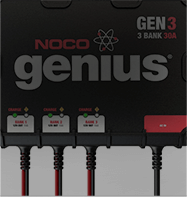
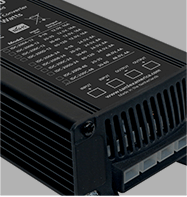
Most garage and consumer type battery chargers are bulk charge only. Most of the cheaper charge controllers for PV systems are bulk only, or bulk plus partial absorption. When using larger battery banks, or the more expensive gelled or AGM batteries it is important that the charge controller you choose has features to protect and prolong the life of your battery.
 
Charge Controllers:
Regulators for solar systems are designed to keep the batteries charging at peak without overcharging. Meters for Amps and Volts are optional with most types. Some charge controllers have built in automatic equalization and taper charge or a maximum power point tracker, which optimizes power output from the PV panels.
 
Maximizers
can increase daily panel output by about 15-20% in summer, and 20-40% in winter. Most better quality controllers can be combined in parallel for higher currents. They also should be are true 3-stage charge controllers and include automatic equalization.

Return to Top

* Above information wholly or in part copyright 1998 by Northern Arizona Wind & Sun Inc.  Used with permission

horizontal rule

Battery Glossary | Products


Home

Last Modified : 02/27/07 11:55 AM

MBC

Copyright 2002